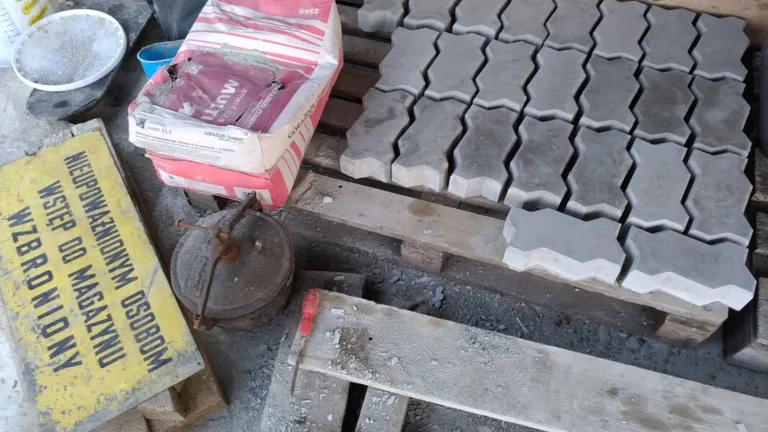
On the advice of my brother-in-law, I have started making concrete paving blocks. These will be laid next to the garage and on the stairs.
The recipe is not too complicated – a blue ice cream box from Algida was used as a measuring cup.
For every 1 box of cement comes 2 boxes of sand, so by putting 14 boxes of sand into wheelbarrows I add 7 boxes of cement. And finally a little water – so ‘by eye’ so that the ‘batter’ is not too thick or too thin. Depending on the weather, the sand is often already wet on its own, so there is no need to measure the water to the millilitre. Then mix it up as far as possible with a trowel or shovel and you can pack it into the moulds 🙂
Grease the moulds beforehand with oil – I used an old kitchen oil (the kind used for chips) – so that the concrete doesn’t stick to the plastic. Put the “dough” inside and shake the mould quite firmly and vigorously – so that later there are no bubbles on the front of the cube. If you have one – you could use a vibrating table for this, then instead of shaking each cube individually you could shake them more wholesale.
The recipe for paving stones is simpler than the recipe for pizza dough.
As for durability – my sister has all the pavements along her house lined with “hand made” pavers. – they have lasted over 15 years and are still going well 😉


When leaving them to dry for 1-2 days, it is best to cover them with something, or secure them so that pets in the area do not walk on them – when the concrete has not yet set, moving the moulds with the cubes can cause them to crack when pulled out.
The neighbourhood cats were very fond of checking the density of the concrete in the moulds, so some of my cubes looked like this after a night:


Repeat the activity several hundred times (as required). Some time later it looks like this:


If you want to be more pro, you can get a vibrating table, in addition to cement you can add polymer fibres for concrete, plasticiser, you can also use dyes, etc.
In my case, I just needed some cubes (about 250 pieces) at a relatively cheap cost and I knew that with this thickness of mould nothing would happen to them, so amplifiers, enhancers etc. were unnecessary.