
Everything about the PQ25 Platform and More
In my posts, I often mention PQ25 modifications, so it would be good to explain what this is all about.
What exactly is a car platform? It’s a unified set of chassis, suspension, drivetrain, and partially body components that serves as the base for building different car models. It’s like a house foundation – one foundation, but you can build different buildings on it.
Why is it worth knowing about this? Knowledge of platforms is the key to understanding which parts are interchangeable between models, which significantly facilitates and reduces the costs of modifications or repairs. Parts from Polo can fit Ibiza, and elements from Fabia can fit A1 – all thanks to the shared platform.
The Volkswagen Group has been using modular platform strategy since the 1970s, which allows it to produce dozens of different models while maintaining economies of scale. The PQ (Plattform Quer) designation system was introduced in 1974 and evolved over decades, up to the current MQB (Modularer Querbaukasten) system.
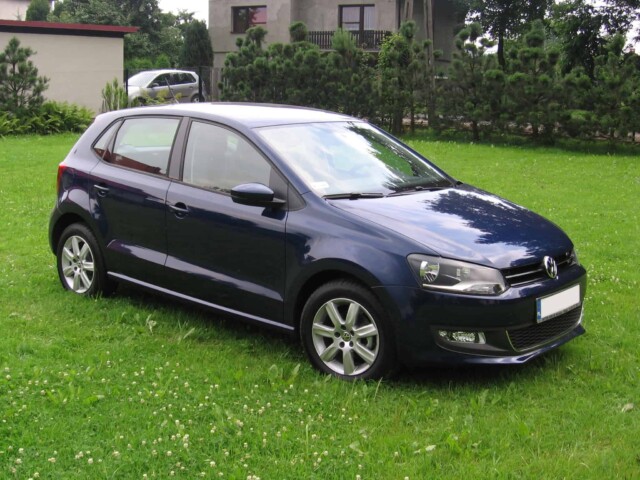
Practical example: If you own a VW Polo 6R (PQ25), many suspension, brake, or chassis components will fit from Seat Ibiza 6J or Audi A1 8X. This should help when searching for used parts or planning modifications.
Volkswagen designates passenger cars with transversely mounted engines as PQ platforms.
Due to size differences, they were divided into several types.
- P – passenger vehicle,
- Q – transversely mounted engine,
- 2 – platform size/class,
- 5 – generation.
Vehicle Classification:
- PQ21/A01: (1974)
- VW: Polo I, Derby I
- Audi: 50
- PQ22/A02: (1981)
- VW: Polo II, VW Derby II (technically speaking, only minor changes compared to the first generation)
- PQ23/A03: (1994)
- VW: Polo III, Polo Classic, Lupo, Caddy (Type 9KV)
- Seat: Ibiza/Cordoba 6K, Arosa 1H/1HS
- PQ24/A04: (2002)
- Audi: A2 8Z (developmental and special model, so some parts are different, e.g., control arms and rear axle)
- Seat: Ibiza 6L1, Seat Cordoba 6L2
- Škoda: Fabia 6Y
- VW: Polo 9N (all variants), Fox 5Z
- VW: Suran/Spacefox, Gol NF MK5 (some PQ25 parts), Voyage MK5, Saveiro MK5
- PQ25/A05: (2009)
- Audi: A1 8X, A1 Quattro (5×112 bolt pattern, PQ35 rear axle and all-wheel drive technology)
- Seat: Ibiza 6J (6J1: 3-door/SC, 6J5: 5-door, 6J8: wagon)
- Škoda: Fabia 5J (narrow PQ25 front axle, PQ24 rear axle)
- VW: Polo 6R
- PQ25+/A05+: (rear axle from PQ34 platform)
- Skoda Roomster+Praktik 5J after 2010 facelift (narrow PQ25 front axle)
- Škoda: Rapid NH (wide PQ25 front axle)
- Seat: Toledo KG (identical to Rapid)
- PQ26/A06: (PQ25 with MQB technology: engines, ESP, assistance systems, electronics, electric power steering, infotainment system)
- Audi: A1, S1 (5×100 bolt pattern, MQB rear axle and all-wheel drive technology)
- Škoda: Fabia 6V (NJ)
- Seat: Ibiza 6P
- VW: Polo 6C
- PQ34/A4:
- Audi: A3 8L, TT 8N
- Seat: Leon/Toledo 1M
- Skoda: Octavia 1U
- VW: Golf 4 1J, Bora 1J5, New Beetle 9C
- PQ35 Platform (A5):
- Audi: A3 8P, TT 8J, Q3 8U
- Seat: Leon 1P, Altea 5P (XL), Toledo 5P (XL)
- Skoda: Yeti 5L, Octavia 1Z, Superb 3T
- VW: Golf 5 1K, Jetta 1K5, Touran 1T, Caddy 2K, Golf Plus 5M, Tiguan 5N
- PQ35 Platform (A6):
- VW: Golf 6 1K, Scirocco Type 13, Jetta Type 162 (6th generation), Beetle 9C
- PQ35 LC (Low-Cost):
- VW: US Jetta MK6 16/AJ – North American (NAR) version 2011+ (uses PQ25 BCM instead of full PQ35), Jetta BS – Chinese version 2013-2019 (also with PQ25 BCM), US Beetle, US Passat
- PQ46 Platform (enlarged PQ35 platform):
- Seat: Alhambra II (from 2011)
- VW: Eos 1F, Passat 3C, Sharan II (from 2011)
- MQB Platform
- too many models to list them all, in short, the successor received a modified front and rear axle, but in many respects remained similar or even identical – especially in the area of chassis and braking systems.
Volkswagen often mixed parts from different platforms in transitional or more budget models, so there was, for example, a Jetta with PQ25 BCM, or Skoda Fabia 5J with rear axle from PQ24. For economic reasons, VW used proven and cheaper solutions from the previous generation.
Key Differences Between Generations
| Platform | CAN | Bolt Pattern | Transmissions (type and housing code) |
|---|---|---|---|
| PQ24 | TP 1.6 | 5×100 | AQ250-6F (09G) MQ200 (02T), MQ250 (02R), MQ350 (0A8), AG4 (01N) |
| PQ25 | TP 2.0 | 5×100 | AQ250 (09G) MQ200 (02T,02U,0DF), MQ100 (0CF) MQ250 (02R), MQ350 (0A8), DQ200 (0AM) |
| PQ26 | TP 2.0 | 5×100 | AQ160 (09G) MQ100 (0CF) MQ200 (02T,02U,0DF,0DQ), MQ250 (0A4), MQ350 (0A8), DQ200 (0CW) |
| PQ34 | TP 1.6 | 5×100 | ? (02K), ? (02C), AG4 (01M), MQ250 (02J), MQ350 (02M) |
| PQ35 | TP 2.0 | 5×112 | MQ200 (0AF, 0AG), MQ250 (0A4), MQ250 (02S), MQ350 (02Q), DQ200 (0AM), AQ250-6F (09G), DQ250 (02E), |
| PQ46 | TP 2.0 | 5×112 | MQ200 (0AJ), MQ250 (02S), MQ350 (02Q), DQ200 (0AM), DQ250 (02E) |
| MQB (2012) | UDS (CAN FD in newer) | 5×112 | AQ160, AQ250 (09G) MQ200 (0AH, 0AJ), MQ250 (02S, 0A4), MQ350 (02Q), DQ200 (0CW), DQ250 (02E, 0D9), DQ381 (0GC), DQ400E (0DD), DQ500 (0BH) |
| MQB A0 | UDS | 5×100 | MQ200 (0DF, 0AF, 02T, 0AJ, 0AG, 0DQ), MQ250 (0A4, 02J), MQ350-6F (02Q), DQ200 (0CW, 0AM), DQ250 (0D9, 02E), DQ381 (0GC, 0BH) |
| MQB A1 | UDS | 5×112 | AQ250 (09G), AQ300, AQ300-8F (09S), MQ200 (0AH,0AJ), MQ250-6F (02S), MQ281 (0C9, ), MQ350-6F (02Q) DQ200, DQ200-7F (0CW), DQ250 (0D9), DQ381 (0GC) |
| MQB A2 | UDS | 5×112 | MQ281 (0C9), MQ350 (02Q, 0BB), MQ500 (0A6) DQ250 (0D9), DQ381 (0GC) DQ400E (0DD), DQ500 (0DL) |
| MQB Evo | UDS / CAN FD | 5×112 | AQ160 (09G), MQ200 (0AF,0AJ), MQ250 (0A4, 02S), DQ200 (0CW), DQ250 (0D9), DQ381 (0GC), DQ400E (0DD) |
Transmissions in the PQ25 platform share internal components with those from PQ34 and PQ35, but have a different (smaller) housing.
Main PQ25/PQ26 engines in Polo 6R/6C etc. (Ibiza 6J/6P, Fabia II/III, A1 8X)
| Engine | Code | Generation | Years | ECU |
|---|---|---|---|---|
| 1.2 MPI | CGPB | EA111 | 2009–2014 | Continental Simos 9.1 |
| 1.2 MPI BlueMotion | CGPA | EA111 | 2010–2014 | Continental Simos 9.1 |
| 1.4 MPI | CGGB | EA111 | 2009–2014 | Magneti Marelli 7GV |
| 1.6 MPI BiFuel | CNKA | EA111 | 2011–2014 | Magneti Marelli MMJ 6GV |
| 1.2 TSI | CBZB / CBZC | EA111 | 2009–2014 | Continental Simos 10.x |
| 1.4 TSI GTI | CAVE / CTHE | EA111 | 2010–2014 | Bosch MED17.5.5 |
| 1.4 TSI BlueGT | CPTA | EA211 | 2012–2014 | Bosch MED17.5.21 |
| 2.0 TSI R WRC Street | CDLJ | EA113 | 2013–2014 | Bosch MED9.1 |
| 1.2 TDI | CFWA | EA189 | 2010–2014 | Delphi DCM3.7 |
| 1.6 TDI | CAYA / CAYB / CAYC | EA189 | 2009–2014 | Continental Simos PCR2.1 |
| 1.6 MPI | CLSA | EA111 | 2010–2014 | Magneti Marelli 7GV |
| 1.4 FSI | CLPA | EA111 | 2009–2014 | Magneti Marelli 7GV |
| 1.4 TSI BlueGT (facelift) | CZEA | EA211 | 2014–2017 | Bosch MED17.5.25 |
| 1.0 MPI | CHYA / CHYB | EA211 | 2014–2017 | Bosch ME17.5.20 |
| 1.0 TSI | CHZB / CHZC | EA211 | 2014–2017 | Bosch MED17.5.21 |
| 1.2 TSI Bluemotion | CJZC / CJZD | EA211 | 2014–2017 | Bosch MED17.5.25 |
| 1.6 MPI (for RU/China markets) | CWVA / CWVB | EA211 | 2015+ | Bosch ME17.5.26 |
| 1.4 TDI CR | CUSA / CUSB | EA288 | 2014–2017 | Delphi DCM6.2V |
PQ25 Platform — Heart of B-Segment
The PQ25 platform was introduced in 2008 as an evolution of the PQ24 architecture. Its main goal was to create a stiffer, safer, and more modern construction designed for B-segment cars, such as:
- Volkswagen: Polo V and Vento
- SEAT: Ibiza IV
- Škoda: Fabia II and Rapid
- Audi: A1
These vehicles were characterized by lengths ranging from 3.97 (in the case of models like VW Polo) to 4.48 meters (in the case of models like Škoda Rapid) and weight from 1000 kg to 1300 kg. The wheelbase ranged from 2.46 m to 2.6 m.
Evolution from PQ24 – Key Construction Changes and Return to Proven Solutions
Although PQ25 was a step forward, in the front suspension, a conscious return to older technologies was made, mainly to reduce production costs.
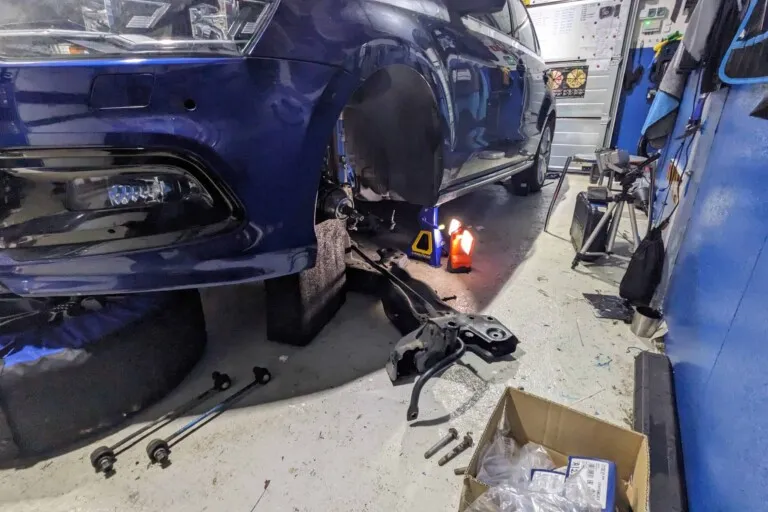
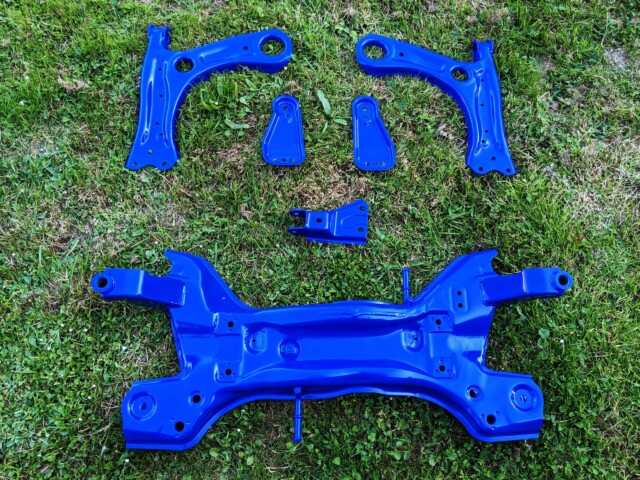
The parent platform, PQ24, was distinguished by an innovative three-piece subframe for its segment. The so-called sled consisted of two lightweight aluminum consoles and a central steel profile. This advanced and rigid solution was originally developed for the mass-optimized Audi A2.
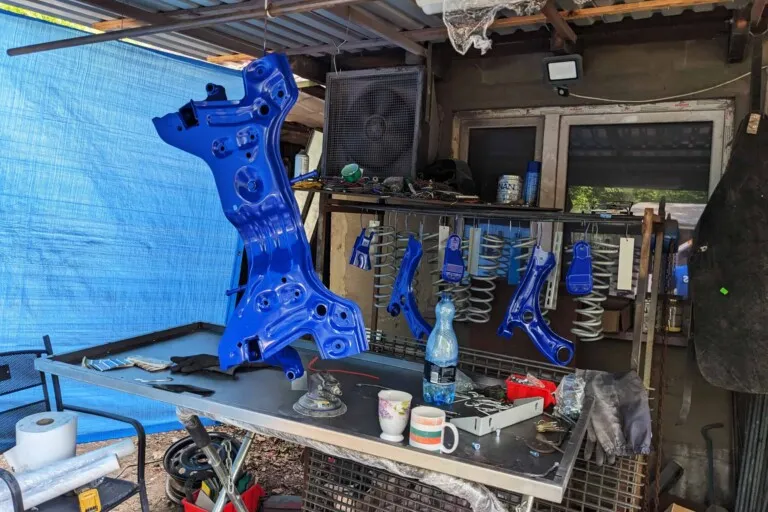
In the PQ25 platform, this more expensive to produce construction was abandoned in favor of a one-piece, welded subframe made of pressed steel. This was a return to the concept known from the older and proven PQ34 platform (used, among others, in Golf IV).


Despite the change being driven by cost savings, it brought tangible benefits:
- Increased rigidity without significant weight increase.
- Easier service maintenance, e.g., replacing control arm bushings no longer required specialized tools for pressing in and out.
- Greater modification potential, including easier installation of larger power units, like the popular 2.0 TFSI.
New Geometry and Better Handling
Along with the new subframe construction, significant changes were introduced in suspension geometry in most models. Compared to its predecessor, the front track width was increased by about 30 mm, and the wheels themselves were moved 5 mm forward. This increased the caster angle of the steering knuckle, which directly translated to improved stability during straight-line driving and better cornering behavior.
Importantly, the Škoda Fabia II (5J), despite belonging to the same platform generation, was an exception. This model retained the narrower track width with shorter control arms, which was an intermediate solution, similar to that of late PQ24 platform cars.


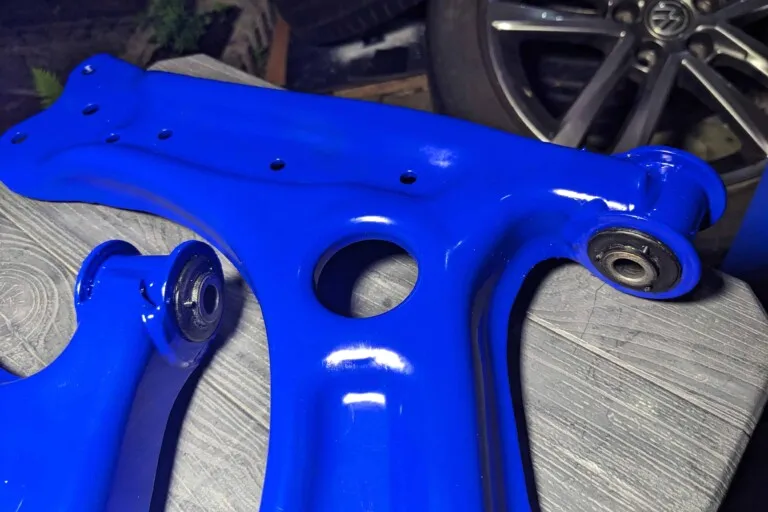
Differences in 6R0 control arms
- Length: control arms for Skoda are shorter
- Rear control arm bushing: Polo 6R i 6C has a regular bushing
1J0407181, while the version for S1 and Cupra has rigid, solid bushings6R0407181B.
For better straight-line stability and improved handling in corners, the ball joints of the “long” PQ25 wishbones were moved 5 mm forward and 15 mm outward compared to those in the “short” wishbones (which were installed, for example, in the Fabia 5J, with its wheel track based on the older PQ24 platform).
| Name | PR-Code | OE Number | Aftermarket |
|---|---|---|---|
| Track control arm, left VW Polo 6R/6C | PR-G17,PR-G19 | 6R0407151F6R0407151A >> 01.11.2010 | Febi FEB39557 |
| Track control arm, right VW Polo 6R/6C | PR-G17,PR-G19 | 6R0407152F6R0407152A >> 01.12.2010 | Febi FEB39558 |
| Track control arm, left Škoda Fabia II – shorter version for the PQ24 wheelbase | 6R0407151E6R0407151 >> 01.12.2010 | ||
| Track control arm, right Škoda Fabia II – shorter version for the PQ24 wheelbase | 6R0407152E6R0407152 >> 01.01.2011 | ||
| Track control arm, left Audi S1, Ibiza Cupra (with a stiff bushing) | PR-G21,PR-G24 | 6R0407151B6R0407151C >> 01.12.2012 | |
| Track control arm, right Audi S1, Ibiza Cupra (with a stiff bushing) | PR-G21,PR-G24 | 6R0407152B6R0407152C >> 01.11.2009 |

Photo source: a2-freun.de/forum/forums/topic/32331-alles-auf-anfang-los-gehts/
Problematic DQ200 Transmission
The PQ25 platform began using a 7-speed automatic transmission designated DQ200. It appeared in the Polo 6R paired with 1.4 MPI, 1.2 TSI, 1.4 TSI, 1.6 TDI engines, and in the facelifted Polo 6C with 1.0 TSI, 1.2 TSI, 1.8 TSI, and 1.4 TDI.
This is a dry clutch construction that has struggled with reliability issues from the beginning of production, mainly concerning faulty mechatronics and low clutch durability. Although the manufacturer introduced improvements over time, this transmission remains sensitive to driving style and is particularly prone to failure in cars with increased power, making it not recommended for tuning. This also contributed to reduced torque in the Polo 6C GTI, which in the manual version (with MQ350) has 320 Nm, while in the DSG7 version (with DQ200) only 250 Nm.
A popular alternative became the more durable 6-speed DQ250 transmission with wet clutches (known from the PQ35 platform), but its installation in PQ25 platform cars requires custom modifications.
Electronics Changes
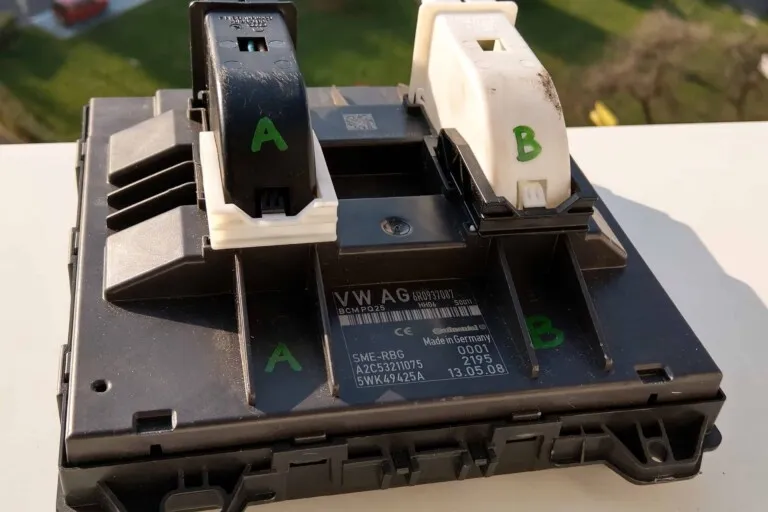
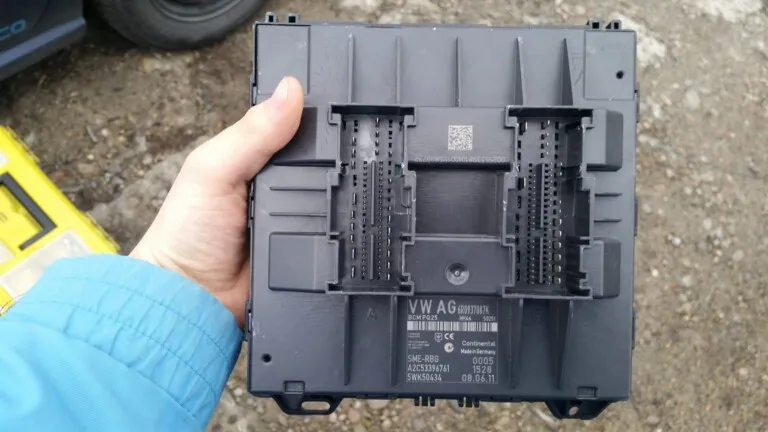
The PQ25 platform also brought changes in electronics. The central comfort controller (J393) and gateway (J533) were integrated into one BCM module (J519), which I described in more detail in the post about BCM PQ25.
Frequently Asked Questions
Which platform is best for tuning?
In my opinion, PQ35 offers the most possibilities and spare parts, it’s easy to find used parts and they’re usually much cheaper than those for PQ25. PQ25, despite its more compact size, didn’t have many sporty versions, so even buying new parts is usually problematic.
Currently, MQB platform cars are becoming increasingly popular, for which used parts are cheap and easily available.
Do PQ35 parts fit PQ25?
Some do, but it requires modifications. Usually adapters or reworking mounts are needed. The main difference is the bolt pattern (5×100 vs 5×112) and axle width. Also, the engine bay differs somewhat – in PQ35 it’s larger and all water lines and transmission mounts are quite different.
Below is an example of a transmission from Audi S3 8P (PQ35) with mounts modified for PQ25:


As you can see, the modification possibilities are enormous, and knowledge of platforms should help in car upgrades 😉